
Why Your Upstairs Is Freezing and Your Basement Is Roasting
If your second floor sits five to ten degrees colder than your first floor every January, the cause is almost never the furnace. In Chicago-area homes it is usually one of four things: return air starved on the upper level, supply ducts that are undersized or leaking through an unconditioned space, dampers still set for summer, or a thermostat mounted on the wrong wall. All four are fixable, and none of them require replacing your heating system.
Why does heat refuse to reach the second floor in winter?
Heat rises, which is exactly why homeowners find the imbalance so confusing. The problem is that a forced-air system does not move air by temperature, it moves air by pressure, and a blower has to push conditioned air up through a duct run that fights friction and gravity the whole way. If the trunk feeding the second floor is undersized, or if it necks down through a tight chase, the upstairs registers get whatever is left after the first-floor branches have taken their share. The basement, sitting closest to the furnace with the shortest, fattest ducts, gets more than its share by default.
Return air is the half of the equation almost everyone forgets. Air pushed into a bedroom has to leave somewhere or the room pressurizes and simply stops accepting supply. Many Chicago two-story homes, especially anything built before the 1990s, have a single central return on the first floor and nothing upstairs at all. Close the bedroom doors at night and each room becomes a pressurized box with a supply register blowing into it and nowhere to exhaust. The room stays cold and the hallway gets warm.
What summer settings are still working against you in December?
Homes with manual duct dampers usually have them set once, in one season, and never touched again. A damper positioned to push cooling upstairs in July is in the wrong position for heating in January, and vice versa. Look along the main trunk lines in the basement for small levers or wing nuts on the duct branches. A lever parallel to the duct means the damper is open; perpendicular means closed. Adjusting them for the heating season is free, takes twenty minutes, and produces a bigger change in comfort than most homeowners expect.
The same goes for individual registers. Closing supply registers in unused rooms feels like a savings move and is not — it raises static pressure across the whole system, which reduces total airflow, stresses the blower, and can trip the furnace's high-limit switch. Leave registers open. If you genuinely need to shift where heat goes, do it at the dampers on the trunk, not at the registers in the room, and never close off more than roughly twenty percent of your supply outlets.
Is your thermostat lying to the furnace?
A thermostat only knows the temperature of the air touching it. If it is mounted on the first-floor hallway near a south-facing window, on an exterior wall, above a supply register, or in the path of sun through a stairwell, it will satisfy early and shut the furnace down while the bedrooms upstairs are still climbing. Homeowners then push the setpoint up to compensate, which overheats the main floor without meaningfully warming the second, and the heating bill goes up for comfort nobody actually gets.
Mounted on an exterior wall — reads several degrees colder than the room, causing overheating.
Above or near a register — reads the supply air, causing short cycling.
In direct winter sun — satisfies early, leaving the rest of the house cold.
In a hallway with all doors closed — reads a space nobody occupies.
In an addition or sunroom — reads the worst-insulated part of the house.
A programmable or smart thermostat with a remote sensor solves much of this without any ductwork. Every complete furnace or AC installation from CCC Mechanical includes a Honeywell T5 WiFi thermostat, professionally installed and configured — details on our promotions page and in our post on why we include a smart thermostat with every system.
What can a technician actually change about airflow?
Balancing is real work with real measurements behind it. A technician takes static pressure readings across the furnace, measures temperature rise between the return and the supply plenum, and takes airflow at individual registers. Those numbers tell you whether the system is moving the air it was designed to move, whether the blower speed tap is set correctly for heating rather than cooling, and where the losses are. Temperature rise outside the manufacturer's rated range on the furnace data plate is a specific, diagnosable problem, not a matter of opinion.
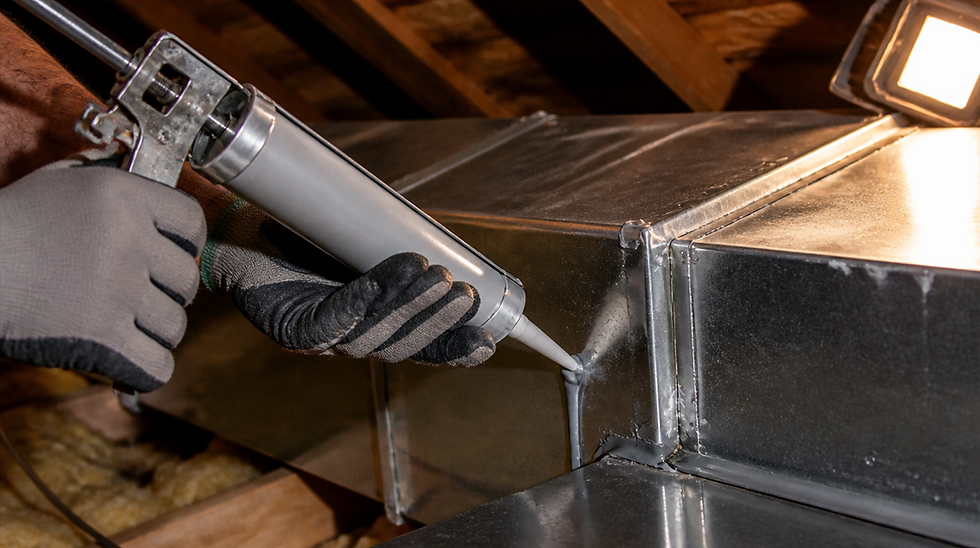
From there the fixes are usually modest. Adjusting the blower speed for the heating season. Sealing duct joints with mastic where the trunk runs through an unconditioned attic or crawl space, which in leaky systems can recover a meaningful share of the heat you are already paying for. Adding a second-floor return, or cutting jump ducts or undercutting bedroom doors so closed rooms can still exhaust. Correcting damper positions. Replacing a crushed or disconnected flex run — which we find more often than you would think in finished basements and remodeled attics.
When is uneven heating actually a sign of a bigger problem?
Sometimes cold upstairs rooms are a symptom rather than the disease. A furnace that is significantly oversized for the house short cycles: it satisfies the thermostat quickly, shuts off before warm air has traveled the full length of the duct run, and leaves the rooms farthest from the equipment permanently behind. That pattern shows up as a warm first floor, a cold second floor, and a furnace that turns on and off every eight minutes on a moderately cold day.
A failing blower motor or capacitor produces the same symptom by a different route — the fan simply cannot move design airflow anymore, and the ducts that suffer first are the longest ones. So does a heat exchanger nearing the end of its life. If your upstairs got noticeably colder over the past two or three winters rather than always having been that way, that change is information. Have someone look at it before the deep cold arrives rather than during it.
Key takeaways
Uneven heating is usually a duct, return air, damper, or thermostat problem — not a furnace capacity problem.
Bedrooms with closed doors and no return pressurize and stop accepting supply air.
Adjust dampers on the trunk lines seasonally; never close registers in rooms to redirect heat.
Thermostat placement on an exterior wall, near a register, or in winter sun causes overheating and short cycling.
Static pressure and temperature-rise measurements turn "it feels cold up there" into a specific diagnosis.
Uneven heat that has gotten worse over recent winters may indicate an oversized furnace or a failing blower.
Frequently asked questions
Should I close vents in unused rooms to push more heat upstairs?
No. Closing registers raises static pressure across the system, reduces total airflow, strains the blower, and can trip the furnace's high-limit safety switch. Adjust dampers on the main trunk instead, and leave room registers open.
Will a bigger furnace fix my cold second floor?
Almost never, and it often makes it worse. An oversized furnace short cycles, shutting off before warm air reaches the farthest rooms. The fix is airflow — ductwork, returns, dampers, and blower settings — not more capacity.
How much temperature difference between floors is normal?
Two to three degrees between floors is typical in a two-story home. A consistent gap of five degrees or more in winter indicates an airflow or duct problem worth diagnosing.
Does CCC Mechanical do airflow balancing in Chicagoland?
Yes. CCC Mechanical LLC performs static pressure testing, duct sealing, damper balancing, and return air corrections across Chicago, Arlington Heights, Buffalo Grove, Elmwood Park, Melrose Park, Niles, and Northbrook. Call 630-827-9024.
Book the $95 Clean & Check and have a technician take airflow and temperature-rise readings while the cabinet is open. See the promotions page or call 630-827-9024.


Comments