
Mold and Musty Basement Odors in Chicago Homes: When It's an HVAC and Humidity Problem
A musty basement smell is almost always a moisture problem before it's a cleaning problem, and the EPA's guidance is direct on this point: the key to mold control is moisture control, because mold cannot grow without it. If your basement smells musty every summer no matter how often you clean, the fix that actually works is reducing humidity, and your HVAC system — specifically whether it includes dehumidification — is usually part of both the cause and the solution.
Why Chicago basements are especially prone to this
Basements sit below grade, stay several degrees cooler than the rest of the house, and often have less airflow than upper floors — three conditions that, combined with Chicago's humid summers, push relative humidity in an unconditioned or poorly conditioned basement well above the 60 percent threshold where mold growth becomes likely. A central air conditioner that's sized correctly for the whole house but rarely runs long enough to dehumidify the basement specifically — because the upstairs thermostat is satisfied first — is a common, underappreciated contributor.
What the EPA actually recommends
The EPA's guidance sets a target of keeping indoor relative humidity below 60 percent, ideally between 30 and 50 percent, and identifies air conditioners and dehumidifiers as the primary tools for getting there, alongside proper ventilation of moisture-producing appliances. A ten-to-fifty-dollar hygrometer from a hardware store is enough to actually measure your basement's humidity instead of guessing from the smell — a basement reading consistently above 60 percent needs a moisture-control fix, not just cleaning.
HVAC-related fixes, from smallest to largest
Confirm supply and return airflow actually reaches the basement. A closed or undersized register starves the space of the conditioning the rest of the house is getting.
Check for duct leaks in unconditioned areas near the basement, which can pull in humid, unconditioned air on the return side.
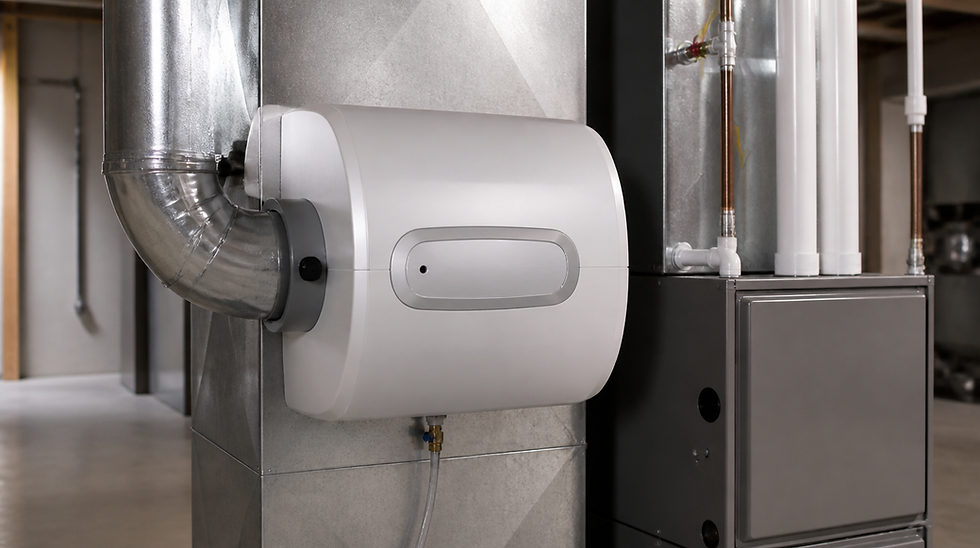
Consider a dedicated dehumidifier tied into the ductwork or standing alone in the basement, for spaces the central system doesn't adequately reach.
Evaluate whether the central AC is properly sized — an oversized system cools quickly and shuts off before it has dehumidified the air, a common and counterintuitive cause of a cold but still-humid basement.
When it's beyond an HVAC fix
If the moisture source is water intrusion — a foundation crack, poor grading, or a sump pump issue — no amount of dehumidification or airflow correction solves the underlying problem; it only manages the symptom. And the EPA is specific that if HVAC equipment itself is contaminated with visible mold, it should not be operated until addressed, since a running system can spread mold spores throughout the building. An HVAC evaluation can tell you which category your basement falls into, but a persistent water intrusion issue needs a waterproofing or foundation specialist, not just airflow changes.
Key takeaways
The EPA is direct: moisture control, not cleaning, is what actually controls mold — mold cannot grow without moisture.
The EPA recommends keeping indoor relative humidity below 60 percent, ideally 30 to 50 percent, using air conditioning and dehumidification.
Chicago basements are especially prone to high humidity due to below-grade cooling, reduced airflow, and humid summers.
An oversized central AC can cool a basement quickly without running long enough to dehumidify it — a common, counterintuitive cause of persistent mustiness.
Frequently asked questions
What humidity level causes mold in a basement?
The EPA recommends keeping indoor relative humidity below 60 percent, ideally between 30 and 50 percent. Basements that consistently test above 60 percent are at meaningfully higher risk for mold growth.
Will running my air conditioner more fix a musty basement?
Sometimes, but not always — an oversized or improperly balanced system can cool a space quickly without running long enough to remove much moisture from the air. A dedicated dehumidifier or an airflow and sizing evaluation often addresses the root cause more directly.
Should I run my furnace fan to help with basement moisture?
Continuous fan operation circulates air but doesn't remove moisture from it — dehumidification requires either an air conditioner actively cooling and condensing moisture, or a standalone dehumidifier. Fan-only operation alone won't fix a genuine humidity problem.
Does CCC Mechanical serve my area in Chicagoland?
CCC Mechanical LLC serves homeowners and businesses across Chicago, Arlington Heights, Buffalo Grove, Elmwood Park, Melrose Park, Niles, and Northbrook. Call 630-827-9024 to confirm service at your address.
Dealing with a musty basement that cleaning doesn't fix? Call 630-827-9024. Ask CCC Mechanical to evaluate whether airflow, sizing, or dehumidification is the actual cause.


Comments