
Furnace Repair or Replace? The Numbers Chicagoland Homeowners Should Run This Winter
Two numbers decide it. First, multiply the repair estimate by the furnace's age in years — if the result exceeds roughly $5,000, replacement is usually the better financial call. Second, check the age against expected service life: gas furnaces in the Chicago area typically run 15 to 20 years, and beyond that a major repair is buying time on a system already near the end. Add a third consideration that overrides both — any cracked heat exchanger means replacement, regardless of arithmetic.
How does the $5,000 rule work in practice?
The rule is simple: repair cost multiplied by equipment age. A $400 repair on a 6-year-old furnace scores 2,400 — repair it without hesitation. A $700 repair on a 14-year-old furnace scores 9,800 — that money is better applied to a new system. A $250 igniter on a 12-year-old furnace scores 3,000, and repairing is still reasonable. The rule is a rough guide rather than a law, but it captures the underlying logic well: money spent on old equipment buys fewer remaining years than the same money spent on new equipment.
What the rule cannot see is failure frequency. A furnace that has needed three service calls in two winters is telling you something the arithmetic on any single repair misses. Components in a furnace age together — the igniter, inducer, blower motor, control board, and gas valve all accumulate cycles at the same rate — so the first significant failure is often followed by others. Two emergency calls in consecutive Januaries is a stronger replacement signal than one large invoice.
Which repairs are worth doing on an older furnace?
Igniter, flame sensor, thermocouple — inexpensive wear parts. Replace at almost any age.
Capacitor, limit switch, pressure switch — modest cost, routine. Worth doing.
Inducer motor, control board — meaningful cost. Apply the $5,000 rule.
Blower motor — significant cost on an older unit. Usually a replacement conversation past 15 years.
Heat exchanger — replace the furnace. A cracked exchanger is a carbon monoxide hazard, and the part cost on an out-of-warranty unit rarely justifies the repair.
Repeat failures of any kind within one season — replacement, regardless of individual repair cost.
One frequently overlooked factor is refrigerant. If your air conditioner is the same age as your furnace and uses R-22, which was phased out of production, servicing it is increasingly expensive. Since the indoor coil sits in the furnace cabinet and the two are usually replaced together, an aging AC materially changes the math on a furnace decision. Consider the system, not the box.
What does a new furnace actually cost to own in Chicago?
The purchase price is the visible number and the operating cost is the one that compounds. Moving from an older 80 percent AFUE furnace to a modern 96 percent unit means roughly 16 percent less gas burned for the same delivered heat — every winter, for the life of the equipment. In a Chicago heating season, where the furnace runs for the better part of six months, that difference is not trivial.
Rebates offset part of the purchase. Per distributor rebate documentation published for 2026, Nicor Gas offers $150 for a gas furnace at 95 percent AFUE or higher and $225 at 97 percent AFUE or higher. The federal 25C tax credit, which previously provided up to $600 toward a qualifying furnace, ended for equipment placed in service after December 31, 2025, so do not build it into a 2026 budget. Confirm current rebate amounts with your utility before purchase, since terms are revised periodically.
Why is timing the decision in winter different from timing it in fall?
A furnace replaced in October is a planned project. You compare quotes, you have time for a proper load calculation, you choose between single-stage, two-stage, and modulating equipment on the merits, and you schedule the install for a day that suits you. A furnace replaced in January, after a failure, in a cold house, is a decision made under pressure — and pressure reliably produces worse decisions about equipment sizing, staging, and price.
Emergency replacements also constrain what is available. Whatever is in stock at the supply house that week becomes your furnace. That may be a fine unit or it may be the wrong capacity for your home, and once installed you live with it for fifteen or twenty years. This is the practical argument for having the conversation while your current furnace is still running: our post on seven signs your furnace won't survive another Chicago winter covers what to watch for.
What should be in a replacement quote?
A quote worth taking seriously specifies the make, model number, AFUE rating, staging, and capacity in BTUs — not just "high-efficiency furnace." It should reference a load calculation performed on your house. It should state what happens to the existing ductwork, whether the venting is being reused or replaced, and whether the new furnace requires a different vent configuration than the outgoing unit. It should list the labor warranty separately from the manufacturer's parts warranty, with terms for both.
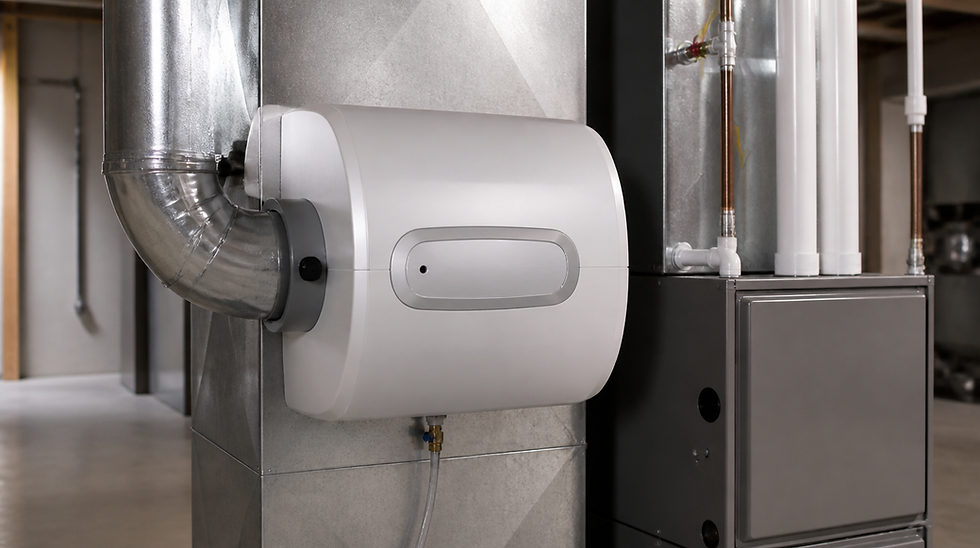
It should also be clear about what is included. Every complete furnace or AC installation from CCC Mechanical includes a free Honeywell T5 WiFi thermostat, installed and configured, and a free Aprilaire whole-home humidifier set to maintain 35 to 45 percent indoor humidity — a meaningful addition in a Chicago winter, where heated indoor air routinely falls below 20 percent relative humidity. Both are listed on our promotions page, and offers apply to new installations by CCC Mechanical and cannot be combined with other promotions.
Key takeaways
Multiply repair cost by furnace age; above roughly $5,000, replacement is generally the better call.
Gas furnaces in the Chicago area typically last 15 to 20 years.
A cracked heat exchanger means replacement, regardless of any arithmetic.
Repeat failures across consecutive winters outweigh the cost of any single repair.
An aging R-22 air conditioner sharing the cabinet changes the calculation — evaluate the system, not the furnace alone.
Nicor Gas rebates of $150 and $225 apply for 2026; the federal 25C credit ended after December 31, 2025.
Frequently asked questions
How long does a furnace last in Chicago?
Fifteen to twenty years is typical for a well-maintained gas furnace in the Chicago climate. Units that have skipped annual service, or that were oversized and short cycled for years, commonly fall short of that range.
Is it worth repairing a 15-year-old furnace?
For inexpensive wear parts like an igniter or flame sensor, usually yes. For an inducer motor, blower motor, or control board, apply the repair-cost-times-age rule — a $700 repair on a 15-year-old furnace argues strongly for replacement.
What is the $5,000 rule for HVAC?
Multiply the repair estimate by the age of the equipment in years. If the product exceeds $5,000, replacement generally makes better financial sense than repair. It is a guideline, not a substitute for a technician's assessment.
Does CCC Mechanical give free replacement quotes in Chicagoland?
CCC Mechanical LLC assesses and quotes furnace and system replacements across Chicago, Arlington Heights, Buffalo Grove, Elmwood Park, Melrose Park, Niles, and Northbrook. Call 630-827-9024 to schedule.
Deciding between repair and replacement? Call 630-827-9024. Every complete installation includes a free Honeywell T5 smart thermostat and a free Aprilaire whole-home humidifier — see the promotions page.

Comments